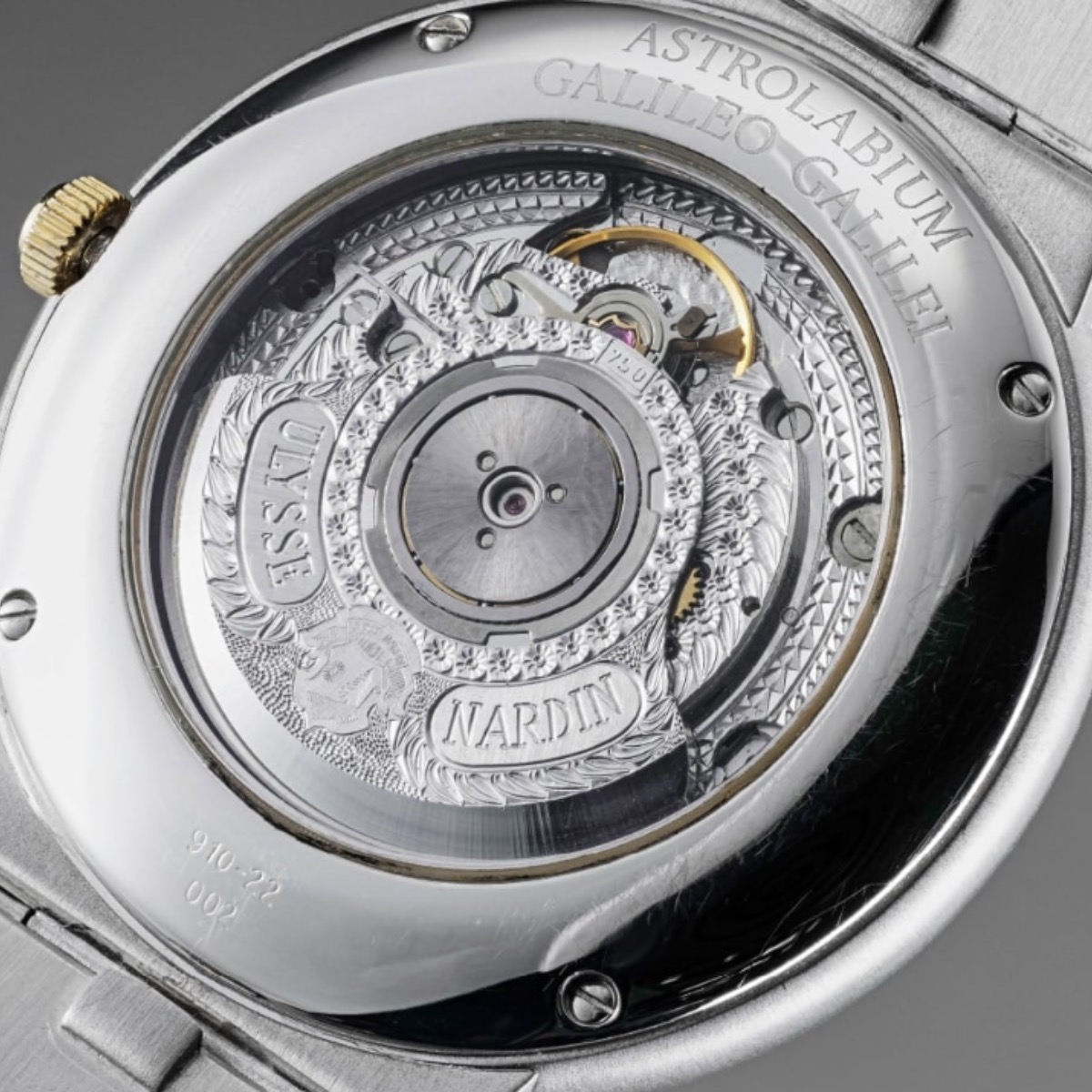
Ulysse Nardin Astrolabium, på auksjon hos
Christie's i dag.
Completing the dial we find several elements:
(1) The grid indicates the cardinal points: north, south, east and west.
The concentric circles are:
(2) The Tropic of Cancer (summer solstice + 23.5°).
(3) The Equator (equinox 0°).
(4) The Tropic of Capricorn (winter solstice – 23.5°).
These circles define the maximum, average and minimum position of the Sun during the year.
(5) The azimuths of the Sun and Moon are indicated by the ascending lines above the horizon.
(6) The horizon, as it can be observed from a specific point.
(7) The two eccentric circles above the horizon are altitude indicators.
(8) The twilight line indicates dusk on the right and dawn on the left.
(9) Time-hour line (only on old models).
The network composed of two parts :
(10) The ecliptic represents the celestial vault (firmament), divided into 12 segments (12 zodiac signs).
(11) The equator represents the calendar with monthly graduations.
The grid takes 23 hours 56 minutes and 4.1 seconds to complete one full revolution, for a 365-day year 5 hours 48 minutes and 46 seconds. This takes into account all leap years in the Gregorian calendar currently in effect.
Lancette:
(12) Day Window: absent on the original 1985 model.
(13) Dragon’s Hand: the dragon’s hand moves at almost the same speed as the grid, but makes one extra revolution every 18,611 years. It indicates solar and lunar eclipses only when it is aligned simultaneously with the hands of the Sun and Moon.
(14) Moon hand: makes one revolution every 24 hours and 49 minutes.
(15) Sun hand: makes one revolution every 24 hours.
Those of you who have been following us for some time have surely sensed our passion for telling you watchmaking stories that go beyond the conventional.

italianwatchspotter.com